

Large Chain Supermarket Underground Parking Lot Charging Pile Project: Co-construction and Sharing Model Activates New Commercial Momentum
2026-03-31

Project Introduction
With the accelerated popularity of new energy vehicles, commercial complexes such as shopping malls and large supermarkets have become important deployment scenarios for urban charging infrastructure. However, traditional charging pile construction is often plagued by high investment costs, long payback periods, and complex operation and maintenance.
A major chain supermarket has innovatively partnered with Green, introducing the 22kW 220V AC Charging Pile GL-1015 to its underground parking lot. Adopting a co-construction and sharing business model, it has successfully transformed charging services from a cost center into a profit center, setting a new benchmark for the green transformation of the retail industry.
Scenario Pain Points: Customers Want EVs but Hesitate to Drive Them
Located in the city’s core business district, the supermarket boasts large daily passenger flow and nearly 1,000 parking spaces in its underground lot. As the number of new energy vehicle owners keeps rising, the supermarket has received numerous customer complaints: many drive here for shopping but cannot find available charging piles. Even the few existing slow-charging piles are often occupied by fuel vehicles or out of service due to aging equipment. This has driven some customers to other shopping malls, resulting in lost potential consumption.
Meanwhile, the supermarket faces a dilemma. Building charging piles independently requires substantial upfront investment in equipment, power renovation and construction, plus a professional team for daily operation and maintenance. Ignoring charging demand, on the other hand, would weaken its competitiveness. Against this backdrop, the co-construction and sharing business model proposed by Green perfectly matches the supermarket’s development needs.
Solution: Green GL-1015 22kW AC Charging Pile
After multiple comparisons and evaluations, the supermarket selected the Green GL-1015 AC charging pile. With a rated power of 22kW and an input voltage of 220V single-phase high-current design, it delivers high charging efficiency.
For customers who spend an average of 1.5 to 2 hours shopping, a 22kW pile can supply 30 to 40 kWh of electricity, boosting the cruising range by 150 to 200 kilometers — fully meeting the demand for a full battery after shopping.
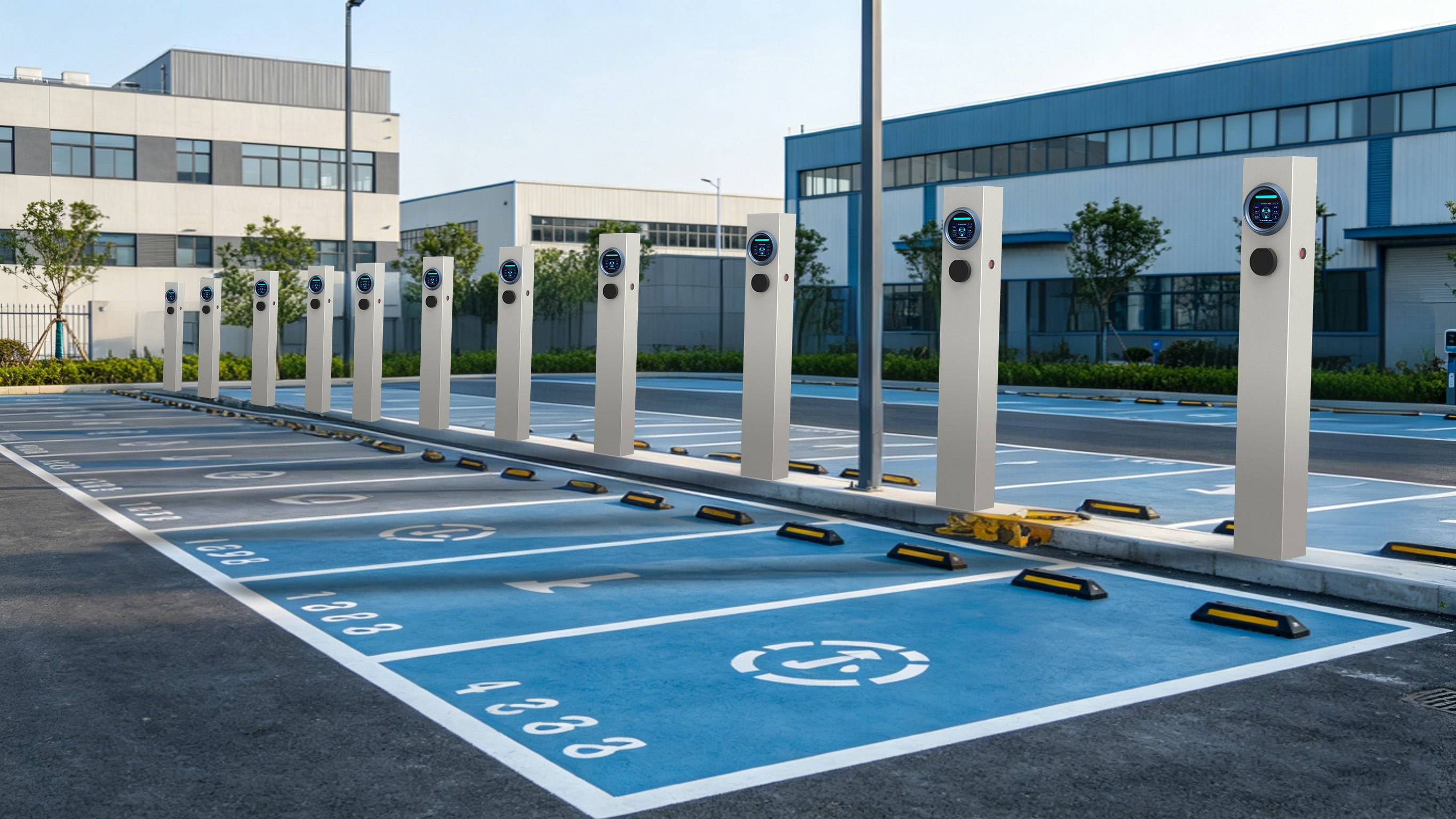
In terms of layout, dozens of GL-1015 charging piles are installed in prime areas of the underground parking lot, near elevator entrances, customer traffic routes and corner large parking spaces. The exact quantity is flexibly configured according to actual parking spaces to form a full-coverage charging network.
The equipment supports wall-mounted and floor-standing installation, making full use of parking lot columns and wall space without occupying additional parking spots. The charging cable is made of crush-resistant and oil-resistant materials, adapting to the humid and dusty underground garage environment. It is also equipped with intelligent gun detection and electronic lock functions to prevent unauthorized charging and accidental unplugging.
Business Model Innovation: Co-construction & Sharing — From Product Sales to Service Operation
The core highlight of this project is the co-construction and sharing model. Under the traditional model, supermarkets purchase equipment outright and take full responsibility for operation and maintenance, bearing heavy investment pressure.
In the partnership between Green and the supermarket: Green provides charging piles, installation, network access and subsequent operation and maintenance; the supermarket offers venue space and power access. Both parties share revenue from charging service fees.
The supermarket bears no hardware procurement cost, only a small portion of electricity fees and venue resources, while gaining long-term stable revenue sharing.
This model enables Green to expand from a pure charging pile manufacturer to a charging operation service provider, creating a new profit point of continuous service revenue. For the supermarket, charging has become a value-added business that not only attracts new energy vehicle owners for shopping and catering during charging, but also generates direct income. Statistics show that after project operation, the average stay time of new energy vehicle customers increased by 20 minutes, and the average customer order value rose by about 12%.
Technological Innovation & Intelligent Management: Data-driven Experience Upgrade
All GL-1015 charging piles are connected to the Green Smart Cloud Platform to realize full-process intelligent management. Supported by IoT technology, the system real-time collects data such as equipment operating status, charging power and fault codes, and optimizes power distribution via algorithms to avoid overload of underground garage power lines.
For user experience, customers can complete all operations via mobile APP or WeChat mini-program: search for idle piles, navigate to parking spaces, scan codes to start charging, check real-time charging progress, and end charging with remote payment.
The APP also pushes thoughtful services including charging progress reminders, estimated full-charge time, and supermarket preferential coupons. For instance, when the vehicle reaches 80% charge, the system automatically sends fresh food discount coupons to guide secondary consumption.
For supermarket management, the cloud platform provides visual operation reports covering charging times, revenue sharing and time-period utilization rates. In terms of operation and maintenance, the system supports automatic fault diagnosis and early warning. Once an abnormality occurs, work orders are automatically assigned to nearby maintenance personnel.
For areas with weak network signals in underground parking lots, the charging piles are built-in with 4G enhanced modules and offline cache mechanisms, ensuring charging can be initiated even offline, with data automatically uploaded once the network recovers.
Project Achievements: Win-win for All Parties, Setting an Industry Benchmark
The project has achieved remarkable results since operation. The average daily utilization rate of charging piles has risen from less than 20% to over 65%, with full occupancy on weekends and holidays.
More than 3,000 new energy vehicle owner labels have been added to the supermarket membership system. In customer satisfaction surveys, the score of charging convenience increased from 2.8 to 4.5 (full score: 5 points). The annual revenue sharing from charging services has fully covered electricity costs with a surplus, becoming a new profit growth point.
For Green, the project verifies the feasibility of the co-construction and sharing model. The company has transformed from an equipment supplier to an integrated solution provider of products + services, with the full-life-cycle revenue per pile increased by about 40%. Meanwhile, the accumulated operational data, user portraits and operation experience lay a solid foundation for replicating the model in other chain supermarkets and commercial complexes.
Future Outlook
Building on the success of this project, the chain supermarket plans to sign a strategic cooperation agreement with Green to promote the same model in its remaining 10 stores in the region.
Going forward, both sides will further explore V2G (Vehicle-to-Grid) technology, interconnection between charging points and supermarket membership points, and pilot projects of solar-energy-storage-charging integration. This will transform supermarket underground parking lots from mere charging sites into urban distributed energy storage nodes, continuously unlocking green commercial value.
Industrial Park Charging Pile Project — 210 Vertical AC Piles Build a Green Energy Network